

by Mark Anderson, ’78 I 8 Mar 2026
Retirement is supposed to mark the completion of a life’s work — a time to finally enjoy the fruits of your labor. In reality, it often begins with questions and uncertainty. Can we afford our lifestyle? Will the money last? What about healthcare? Will we still travel?
And then the bigger one appears: Who am I if I’m no longer my job title?
I spent 35 years at the Central Intelligence Agency, and I use the word ‘enjoyed’ deliberately. The work mattered. The Agency invested in its people – training, education, advancement, healthcare, pensions – even a two-week course on how to retire.
In 2014, after leading a highly successful joint-services international mission, I decided to leave on a high note. In 2015 I turned in my badges and walked away from federal service.
Below are questions I’ve been asked about retirement and the Agency:
Q: What surprised you most about the first year of retirement?
I was shocked at how busy I was. I honestly wondered how I ever kept up with normal life while working full-time.
Q: What did you not expect to miss?
I missed being in the know. The Agency makes a clean break. Friends still ask my opinion on world events, but I haven’t had ground-truth information in ten years.
The second thing I didn’t think I’d miss has to do with my ego. I worked hard and rose through the ranks. Then one day, instead of Mr. Anderson, I was Mr. Nobody. I made peace with it quicker than I expected.
 Q: What from your years at Clark AB do you understand differently now?
I think about my father a lot. I was always so absorbed with my own life that I never considered what he was going through. He served his country, left two of his adult children behind in the States, and after Clark, he retired and got a government job. I never stopped to consider what that transition felt like for him — separation from family, loss of identity, uncertainty.
He seemed unshakable. Now, I wonder if he carried the same worries I did at each stage of life. I also wonder what he thought about at 66 — my age now. I know he didn’t think he only had a year to live.
Q: Is there a story you can tell now that you’re retired?
Absolutely not!
My neighbors try. Anything I write must go through the Agency’s Publication Review Board.
That said, I can say I was honored to have briefed President George H.W. Bush several times and we corresponded after he left office. I can also say I once spent eight days stranded without communication in North Asia – 75 below zero, with howling winds and snow to the rooftops – until a 15-minute break in the weather gave us just enough time to board a helicopter and get out. We made it.
Q: What does Hollywood get wrong about the CIA?
When people learn where I worked, they ask whether shows like Homeland are accurate. I just smile and shake my head.
Government technology and capability exceed Hollywood’s imagination – but the real mistake is the lone-hero myth. No single person saves the day. Hundreds of analysts, researchers, and specialists make operations possible.
Like the Air Force, it takes far more than a pilot to make a plane fly.
 Q: What high-school interest do you still pursue?
Writing. I wrote during my career, but retirement lets me write for myself – I’ve written two books. I also play a lot of golf. [Mark has written two books — Sage Among the Pines and Shadows of Saigon — available on Amazon.com.]
Q: Has retirement allowed you to reconnect with any part of yourself?
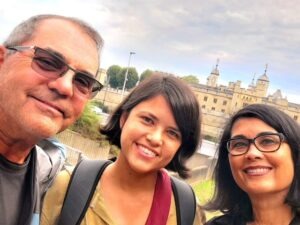
During my career I traveled constantly. Now I travel by choice with Liz and Jackie.
I was exposed to some of the worst things people do to each other. Retirement has slowly allowed me to let go of that weight and rediscover ordinary joys.
On a lighter note, I’ve also reconnected with my joints. They remind me daily of the sports abuse I gave them years ago.
Liz always knew when the world felt heavy on my shoulders, though neither of us shared war stories. We’ll happily trade stories about grandkids, fishing trips, and golf rounds instead.
See you in October.
###
All statements of fact, opinion, or analysis expressed are those of the author and do not reflect the official positions or views of the US Government. Nothing in the contents should be construed as asserting or implying US Government authentication of information or endorsement of the author’s views.
One Response
I so enjoyed reading this, Mark! Especially since I’m not retired yet. Looking for to seeing you and Liz in San Antonio!